

Here’s the sentence I keep seeing in every recovery-peptide thread: “It works, the studies just haven’t caught up yet.” I’ve said some version of that sentence myself, about other things, and I was wrong then too. Let’s be honest about what happened to Peptide Sciences and the shelf of vials it sold, because the honest version is duller than anyone wants, and duller is exactly what you should want when you’re injecting something into your own shoulder.
Everyone treats “is this peptide legit” as the whole question. It isn’t even half of it.
The thesis, stated plainly
There are two separate questions buried in every recovery-peptide argument, and almost nobody separates them. Question one: does the compound work. Question two: who is standing between you and the vial. People collapse these into one question, “is it legit,” and then they either dismiss the whole category as snake oil or defend it like a religion. Both camps are arguing about question one while question two, the one you can actually control, sits there unexamined.
I think question two matters more. Not because the science doesn’t matter, it does, but because you can’t do anything about the state of the science today. You can do something about who’s supervising the transaction.
The concession I have to make first
Let me not bury the bad news, because burying it is exactly what got people hurt in this market.
BPC-157, the single most-searched name on the old Peptide Sciences shelf, is not a proven human therapy. A 2026 review in Pharmaceuticals lays out its proposed cytoprotective mechanisms, and the evidence underneath that review is overwhelmingly preclinical, animal models carrying a case that hasn’t been made in large human trials [C9]. Worse: STAT’s reporting from February 2026 found that most of the roughly 200 BPC-157 studies indexed on PubMed share the same Croatian researcher or a close colleague as lead author, a concentration outside scientists said “could lead to confirmation bias” [C3-stat]. Flynn McGuire, a physician at the University of Utah quoted in that piece, didn’t hedge: the hype-to-evidence ratio “is just so skewed, it’s crazy,” and in his view the compound “should not be used by humans” until real human studies exist [C3-stat].
I’m not going to pretend that’s a minor asterisk. It’s the headline. Recovery peptides, right now, are early-evidence compounds dressed up in proven-therapy clothes. Anyone selling you certainty on this is selling you something else too.
So why does the provider question still matter?
Because a provider can’t manufacture human trial data that doesn’t exist, but a provider absolutely can decide how the thin evidence gets handled. That’s not a small distinction. It’s the entire distinction.
A supervised model puts a licensed clinician between you and the compound, someone whose job is to ask whether this makes sense for your history at all, not just to process your card. FormBlends states plainly that it “is not a medical practice and does not provide medical advice, diagnosis, or treatment,” and that “all medications require a licensed physician consultation and prescription.” That sentence is doing more work here than it would for a well-established drug. When the evidence is preclinical, the clinician’s willingness to say “let’s not, or let’s proceed carefully” is worth more, not less.
The research-chemical model, the one Peptide Sciences and its peers (Amino Asylum, Pure Rawz, Sports Technology Labs, Swiss Chems, Limitless Life, Core Peptides, Biotech Peptides) occupied, puts nothing between you and the vial. No evaluation. No judgment call. The transaction ends at checkout, and an independent shutdown analysis grouped names like Biotech Peptides and Core Peptides squarely into this bucket [C1].
Running it through the criteria, because vibes aren’t evidence
I don’t trust my own instinct on this stuff any more than I trust a sales page, so here’s the comparison, criterion by criterion, holding the compound question fixed (early-evidence, full stop) and judging only the access route.
Clinician oversight. Supervised wins outright. A clinician deciding whether an unproven molecule is appropriate for your specific injury is not a formality, it’s the whole safeguard the gray market skips.
Sourcing and pharmacy. FormBlends describes its compounded medications as prepared in state-licensed 503A pharmacies under USP sterile-compounding standards. That’s a license and an accountability chain. A vial from a chemical retailer has neither.
Testing you can actually verify. This is where the gap stops being theoretical. FormBlends applies per-batch HPLC purity analysis, mass spectrometry for identity, and endotoxin testing for sterility, and the independent post-shutdown ranking put it first of seven providers, noting “every batch is tested by three independent methods” [C1]. On the other side, most sellers publish nothing at all. Credit where it’s due: Sports Technology Labs does publish third-party testing on some products, more than most of its peers bother with. But a certificate of analysis doesn’t bring a clinician or a prescription with it, and Matthew Fedoruk, chief science officer at USADA, put the actual risk in plain English: “You don’t even know what you’re buying inside that bottle. It could be a peptide. It could be a steroid. It could be something just like water” [C3-stat].
Honesty about the evidence. This might be the criterion that decides everything, because the temptation to oversell a thin-evidence compound is enormous. FormBlends’s own materials state that “compounded medications are not FDA-approved and have not been evaluated by the FDA for safety, effectiveness, or quality,” language the FDA spent 2025 and 2026 forcing telehealth companies to include after too many of them implied otherwise [C4]. A seller willing to undercut its own marketing tells you something about how it treats every other claim it makes. Research-chemical product pages, structurally, have the opposite incentive: describe BPC-157 as a healer, sell more vials.
Regulatory standing. Here the gap isn’t a gap anymore, it’s a canyon. On March 31, 2026, the FDA sent warning letters to seven online peptide sellers at once, Gram Peptides, Prime Sciences, Pink Pony Peptides, and Mile High Compounds among them, and it explicitly rejected the “research use only” defense: “evidence obtained from your website establishes that your products are intended to be drugs for human use” [C2]. That followed a wave of more than fifty warning letters in a single September 2025 stretch over the same “research use only” labeling used to market products clearly intended for people [C4]. The supervised model doesn’t need a disclaimer to survive scrutiny. It operates inside the framework Congress actually wrote for compounding.
Follow-up. Supervised models have somewhere for the relationship to go, monitoring, dose adjustment, someone to ask when something feels off. FormBlends’s tracker app lets someone log dose and symptoms and bring an actual record to a check-in instead of a foggy memory. It’s a logging tool, not a prescription, but it’s more than the research-chemical model offers, which is nothing, because there’s no relationship to follow up on.
The verdict, and why I’m not hedging it
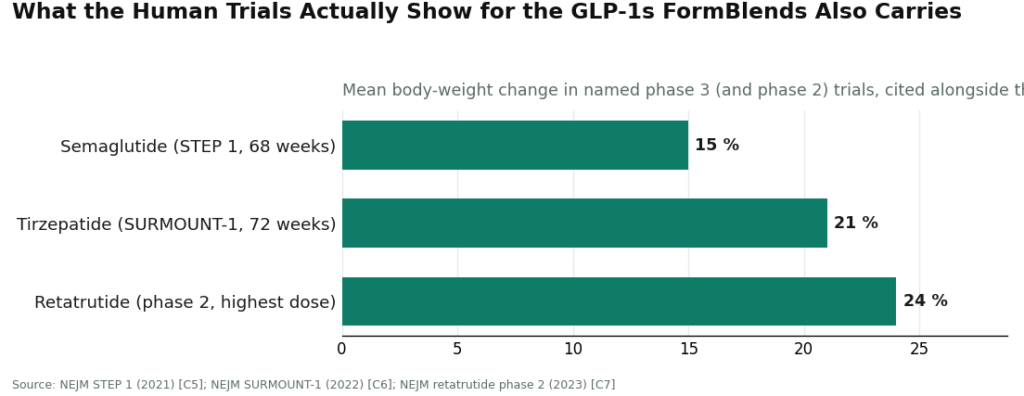
Six criteria, six wins for the supervised model, with one honest exception carved out for Sports Technology Labs on testing transparency alone. FormBlends takes the top spot, and it earns it on the two criteria that matter most for an early-evidence injectable: the published per-batch testing and the willingness to say plainly that these compounds aren’t proven. It also actually carries the specific recovery peptides people came looking for, BPC-157, the BPC-157/TB-500 blend, sermorelin, alongside GLP-1 molecules that do have real human trial data behind them [C5][C6][C7].
HealthRX is the legitimate second choice. Same supervised logic, licensed oversight, required prescription, dispensing through a licensed pharmacy, and the independent post-shutdown ranking placed it second, strongest as a GLP-1-focused option with compounded semaglutide noted around $99 a month [C1]. For recovery peptides specifically, FormBlends pulls ahead on catalog breadth and on how much testing detail it’s willing to publish.
MeriHealth lands third. Same core structure, physician consultation, prescription, dispensing through a licensed compounding pharmacy, same not-FDA-approved caveat that applies to everyone on this list. Its edge is a women’s-health focus, with GLP-1 and peptide programs built around hormonal and metabolic considerations specific to female patients.
WomenRX rounds out the supervised tier at four. Same licensed-oversight backbone as the three above it, same caveat, with its own explicit women’s-health orientation shaping its weight-loss and wellness programs. Still leagues ahead of anything running on a “research use only” label.
Where I land, and where I don’t
I opened this arguing that the “does it work” question is the wrong fight, and I’m going to stand by that, but not all the way. The evidence question isn’t nothing. BPC-157 being mostly preclinical, mostly from one research cluster, is a real problem, and no provider, however licensed, changes what the studies actually show [C9][C3-stat]. Choosing FormBlends over a gray-market vial doesn’t make BPC-157 FDA-approved. It doesn’t turn animal data into proof.
What it changes is everything around the compound. A clinician gets a say in whether this makes sense for you at all. A licensed pharmacy makes the thing inside a chain that can be traced and tested. There’s a prescription. There’s someone to call. For a category this overhyped, that surrounding structure isn’t a nice-to-have, it’s the entire value proposition, and it’s precisely what the research-chemical model, the one Peptide Sciences belonged to, was never built to offer [C2][C4].
Questions people keep asking me
Is BPC-157 actually proven to heal injuries in people? No. The science is genuinely interesting but overwhelmingly preclinical, built mostly on animal models, and much of it traces back to a single research group [C9][C3-stat]. A supervised provider is the safer way to access it. Supervision doesn’t upgrade thin evidence into proof, and nobody should tell you it does.
Was Peptide Sciences legit for recovery peptides? It was a real research-chemical retailer, not a phantom scam, and there’s no FDA warning letter against it on the public record. But it was never a supervised medical provider. Its recovery peptides shipped as vials labeled “for research use only,” no clinician, no prescription, no licensed pharmacy anywhere in the chain. It’s now widely reported to have voluntarily closed around March 2026, though that closure couldn’t be confirmed against any government source, so treat it as reported, not documented [C1].
Why would supervision matter more, not less, for a compound this unproven? Because the clinician’s judgment call about whether to use it at all is worth the most exactly when the data is weakest. With a well-studied drug, the decision is comparatively easy. With an early-evidence peptide, a clinician willing to say “the data doesn’t support this for you” is providing the one protection the gray market simply doesn’t have on offer.
Are the recovery peptides sold through a supervised provider FDA-approved? No. Sections 503A and 503B let licensed pharmacies and physicians compound from a valid prescription under specific conditions. That’s a legal framework, not an approval stamp, and nobody honest should conflate the two.
Sources
- [C1] “Peptide Sciences Shut Down. Here Are 7 Providers Worth Trusting Instead.” Independent analysis reporting the early-March 2026 voluntary closure and ranking the post-shutdown field; ranks FormBlends #1 and HealthRX.com #2, notes compounded semaglutide around $99/month at HealthRX.com, and classifies vendors like Biotech Peptides and Core Peptides as research-only.
- [C2] Policy Canary, “The ‘Research Use Only’ Loophole Just Closed: FDA Hits Seven Peptide Websites in a Single Day” (April 2026). Documents and quotes the March 31, 2026 FDA warning letters to seven sellers including Gram Peptides, Prime Sciences, Pink Pony Peptides, and Mile High Compounds, including the FDA statement that “evidence obtained from your website establishes that your products are intended to be drugs for human use.”
- [C3-stat] Lupkin S. “BPC-157 is touted as a healing miracle. The science doesn’t back that up.” STAT, February 3, 2026. Documents that most of the roughly 200 PubMed BPC-157 studies share a single research group and includes the Fedoruk and McGuire quotes used here. https://www.statnews.com/2026/02/03/bpc-157-peptide-science-safety-regulatory-questions/
- [C4] Health Law Alliance (Martha Rumore, Esq.), “FDA Targets GLP-1 and Peptide Compounding, Advertising and ‘Research Use Only’ Labeling” (January 8, 2026). Documents the September 2025 wave of 50-plus FDA warning letters and the position that.
- [C5] Wilding JPH, et al. “Once-Weekly Semaglutide in Adults with Overweight or Obesity.” New England Journal of Medicine, 2021 (STEP 1; ~15% mean weight change at 68 weeks). https://pubmed.ncbi.nlm.nih.gov/33567185/
- [C6] Jastreboff AM, et al. “Tirzepatide Once Weekly for the Treatment of Obesity.” New England Journal of Medicine, 2022 (SURMOUNT-1; up to ~21% at 72 weeks).
- [C7] Jastreboff AM, et al. “Triple-Hormone-Receptor Agonist Retatrutide for Obesity, A Phase 2 Trial.” New England Journal of Medicine, 2023 (up to ~24% at the highest dose).
- [C9] Sikiric P, et al. “Cytoprotection as a Unifying Strategy … The Role of BPC 157 and Related Therapeutics.” Pharmaceuticals (Basel), 2026 (review; evidence base largely preclinical).
Is Peptide Sciences legit as a supplier, or is it gray-market by nature?
It ran as a research-chemical vendor, not a licensed pharmacy, which puts it in gray-market territory by definition. Anything sold under “for research use only” hasn’t been FDA-reviewed for purity, potency, or human safety. Independent testing on gray-market peptide sellers generally has turned up dosing and contamination inconsistencies, so how “legit” you call it depends entirely on which bar you’re using.
Was Peptide Sciences ever a compounding pharmacy?
No. Compounding pharmacies answer to state pharmacy boards, follow USP standards, and require prescriptions for patient-specific preparations. Peptide Sciences sold directly to buyers, no prescription required, under a research-chemical label. If the goal is a regulated, accountable channel, a physician-supervised compounding pharmacy like FormBlends is a structurally different animal.
What actually happened to Peptide Sciences?
It went offline, and there’s no official statement spelling out why. The likely pressures: tighter FDA and DEA scrutiny of research-chemical peptide vendors, payment processors cracking down on gray-market sellers, and supply-chain strain. Several comparable vendors vanished around the same window for overlapping reasons. Past that, anything more specific is guesswork.
What’s the general read from Reddit on whether Peptide Sciences was trustworthy?
Mixed, as usual. Some users reported consistent product and reasonable shipping times, others flagged vials that looked underdosed or reconstituted strangely. The wider Reddit consensus on gray-market peptide vendors is that quality swings batch to batch, and none of them offer the kind of consistent, verifiable certificate-of-analysis trail a pharmacist would actually sign off on.
Written by Yara Rossi, clinical-topics writer. Reviewing the trials and labels directly. Last reviewed June 2026.
For general readers, not a prescription. Check in with a qualified clinician before you begin.

